

The international geopolitical landscape is in a period of profound realignment, where traditional balances of power are being challenged and new centers of influence are emerging rapidly.
Within this environment, Turkey is emerging as one of the most flexible and strategically positioned actors, particularly in the context of European security.
Developments, combined with the uncertainty caused by the foreign policy of the United States under Donald Trump, are creating a new framework in which Europe is likely to turn more decisively toward Ankara.
This dynamic, while strengthening Turkey’s geopolitical position, may create significant challenges for countries such as Greece, which are geographically and strategically close to this transformation.
The shift in US policy and the gap in Europe
In recent years, the foreign policy of the United States has changed noticeably, with less emphasis on multilateral cooperation and greater emphasis on national interests.
Pressure on NATO and the European Union EU, as well as threats of US withdrawal from key institutions, have caused concern among European allies.
In this context, Europe is called upon to redefine its strategic choices.
The need for a strong regional partner is becoming increasingly urgent, and Turkey appears to be the natural candidate to fill this gap.
Turkey as an indispensable strategic partner of Europe
The Minister of Defense of Turkey, Yaşar Güler, has already emphasized the importance of his country for European security.
His statement that Turkey is no longer a “regional ally” but a “central pillar of security” reflects a deeper reality: Ankara possesses the geographic, military and diplomatic power to influence developments on multiple fronts.
Turkey’s participation in NATO since 1952 has given it experience and interoperability with Western powers.
However, its exclusion from the European Union created a gap, which now appears to be reassessed in light of new threats, as explained in an analysis by the National Interest.

Yaşar Güler
Multidimensional diplomacy - Ankara’s strong card
One of Turkey’s most important advantages is its ability to function as a “bridge” between different worlds.
Its policy of “zero problems with neighbors” allows it to maintain open channels of communication with countries and regions that are often in conflict.
Ankara under President Recep Tayyip Erdogan has assumed a mediating role between the United States and Iran, while at the same time maintaining a balance in its relations with Ukraine and Russia. The President of Ukraine, Volodymyr Zelensky, publicly acknowledged the importance of Turkey, noting that without it, Europe cannot balance Russian power.
This flexibility is not a sign of weakness or instability, but a deliberate strategic choice that allows Turkey to increase its international influence.
Military strength and technological superiority
One of the key factors strengthening Turkey’s position is the development of its defense industry, particularly in the field of drones.
The company Baykar has managed to place Turkey at the top of the global unmanned aerial vehicle market.
The Bayraktar TB2 has proven particularly effective in modern conflicts, offering low cost and high performance.
Compared to American systems such as the MQ-9 Reaper, Turkish drones are more affordable and flexible, making them attractive to many countries.
The proposal of the President of the European Commission, Ursula von der Leyen, for the creation of a European “drone wall” further strengthens the importance of Turkey as a supplier and technological partner.
Deepening relations with Europe
Turkey has already begun to strengthen its cooperation with European countries.
The agreement with the United Kingdom for the purchase of Eurofighter fighter jets, supported by Prime Minister Keir Starmer, is a characteristic example of this trend.
At the same time, cooperation on issues of migration, counterterrorism and energy security strengthens Turkey’s image as a reliable partner.
Implications for Greece
The strengthening of Turkey’s geopolitical position cannot but affect Greece.
As Europe turns toward Ankara for security and stability, Athens is expected to find itself in a more difficult position within the framework of European balances.
First, Turkey’s increased influence may limit Greece’s ability to promote its positions on issues such as the Aegean and the Eastern Mediterranean.
If Turkey is considered an indispensable partner for European security, Europeans may be more reluctant to exert pressure on it.
Second, Turkey’s military strengthening, particularly through drone technology, creates a new balance of power in the region.
Greece is called upon to adapt to an environment where Turkey has a significant advantage in certain areas.
Third, Ankara’s diplomatic flexibility allows it to maintain relations with multiple actors, strengthening its negotiating position.
In contrast, Greece, as more closely connected to the European Union, may have fewer margins for maneuver.
A new European security architecture
As we approach 2028 and the next American electoral contest, the possibility of further distancing of the United States from Europe remains real.
In this scenario, countries such as France, Germany and the United Kingdom may seek closer cooperation with Turkey for the reorganization of European defense against the backdrop of a withdrawal of American forces from Europe.
Ankara, with its strategic position and growing power, appears ready to play a leading role in this new architecture.
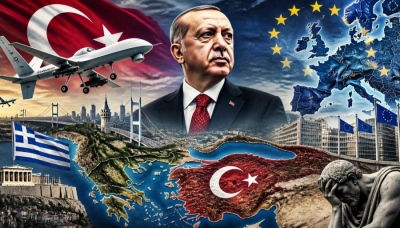
Erdogan as the major winner
The rise of Turkey as a key factor in European security is one of the most significant geopolitical developments of our time.
Its ability to combine military power, technological innovation and diplomatic flexibility makes it a particularly valuable partner for Europe.
However, this development is not neutral for all.
For Greece, it creates a more complex and demanding environment, where the need for strategic adaptation and strengthening of its own position becomes more urgent than ever.
The next decade will show whether Greece can respond to these challenges or whether Turkey’s rise will profoundly alter the balances in the region.
In any case, Ankara’s trajectory appears to be upward, and its influence in Europe will be difficult to ignore.

www.bankingnews.gr





Σχόλια αναγνωστών